
Your Financial Power of Attorney Might Not Work When You Need It Most
Having a Financial Power of Attorney is a great first step — but many banks won't accept one prepared by an outside attorney. Once a person becomes incapacitated, it's too late to fix the paperwork. We explain the gap most people miss, which states offer legal protections, and the simple questions you should be asking your bank today.
Christopher Flis
3/18/20263 min read

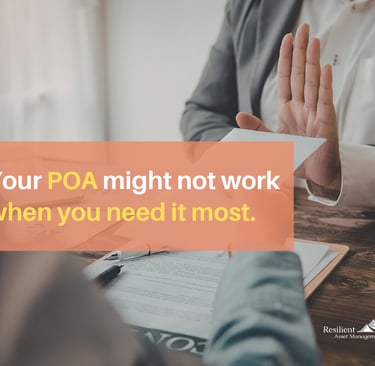
If you have a Financial Power of Attorney, congratulations — you are ahead of the game. Most people don't even have one. But here's the uncomfortable truth: having one prepared by your estate attorney does not guarantee it will be accepted when it matters most.
Let me say that again for emphasis: the document sitting in your filing cabinet right now might be worthless at the very institution where you need it to work.
The Problem
Here's a scenario I have seen play out more than once. A person becomes incapacitated — perhaps due to a stroke, an accident, or the progression of dementia. Their spouse or adult child, armed with a properly prepared Financial Power of Attorney, walks into the bank to manage the person's affairs. And the bank says no.
Why? Because many banks and financial institutions will not accept a Power of Attorney prepared by an outside attorney. Instead, they require that a Power of Attorney designation be completed on their own proprietary form. If that form was never completed while the person was still competent, you're stuck. And here is the critical point that makes this so urgent:
Once a person becomes incapacitated, they can no longer execute legal documents.
That means you cannot go back and fix this after the fact. If the bank's own Power of Attorney form was never signed, your only recourse may be a costly and time-consuming court proceeding to establish a guardianship or conservatorship. That is an outcome nobody wants.
Some States Protect You — Others Don't
Not all states treat this problem the same way.
Florida, for example, offers strong protections under its Power of Attorney Act (Chapter 709, Part II of the Florida Statutes). Specifically, Florida Statute § 709.2120 requires that a third party — including banks and financial institutions — must accept or reject a power of attorney within a reasonable time, presumed to be four business days for financial institutions. Critically, the statute states that a third party may not require an additional or different form of power of attorney for authority granted in the one presented. A bank that improperly refuses to accept a valid Power of Attorney in Florida is subject to a court order mandating acceptance.
That's a meaningful consumer protection.
However, many other states have no such law on the books. In those states, a bank can effectively say, "We don't accept outside Powers of Attorney — you need to use our form," and there may be little legal recourse. If you live in one of these states, the burden falls squarely on you to be proactive.
My Strong Suggestion
Regardless of where you live, here is my strong suggestion: go to your bank and every other financial institution of importance, and confirm that a Power of Attorney is in force.
Specifically, ask these questions:
1. Will you accept the Financial Power of Attorney prepared by my estate attorney?
2. If not, do you have your own Power of Attorney form that needs to be completed?
3. If so, can I complete that form now while I am able to do so?
Do this for your bank, your brokerage firm, your retirement plan custodian, and any other institution where you hold meaningful assets. Do it now, while everyone involved is competent and able to sign documents.
This is one of those financial planning tasks that takes an afternoon to complete but can save your family an enormous amount of stress, expense, and heartache down the road.
The Bottom Line
Having a Financial Power of Attorney is essential — it is a cornerstone of any sound estate plan. But having one prepared is only the first step. Ensuring it will actually be honored at your financial institutions is the step most people miss. Don't be one of them.
As always, if you have questions about this or any other financial planning matter, please don't hesitate to reach out.
Contact
502 S Main Street, Memphis, TN 38103
© 2026. All rights reserved.